Peaking into the abyss
Here is a weird question: how “zero” can samples from a standard unit Gaussian actually get? Sure, the mean is zero. But that’s just a statistic. How much mass is around zero? Gaussian-weighted components are abundant in inference; can they ever truly “switch off” ?
Let and consider the smallest magnitude among samples:
Near zero the Gaussian density is essentially flat,
so mass scales linearly:
Invert this heuristic and you obtain a clean rule:
After samples, the smallest value you typically see is on the order of .
More precisely,
So:
| samples from | expected minimum |
|---|---|
Every decade of samples gets you another order of magnitude near what I call “the abyss floor.”
Looking at the abyss on a log scale
A convenient way to visualize this is to define
Now each unit step left corresponds to another factor of ten toward zero.
The density becomes
for very negative . Each additional decade loses a factor of ten in probability mass.
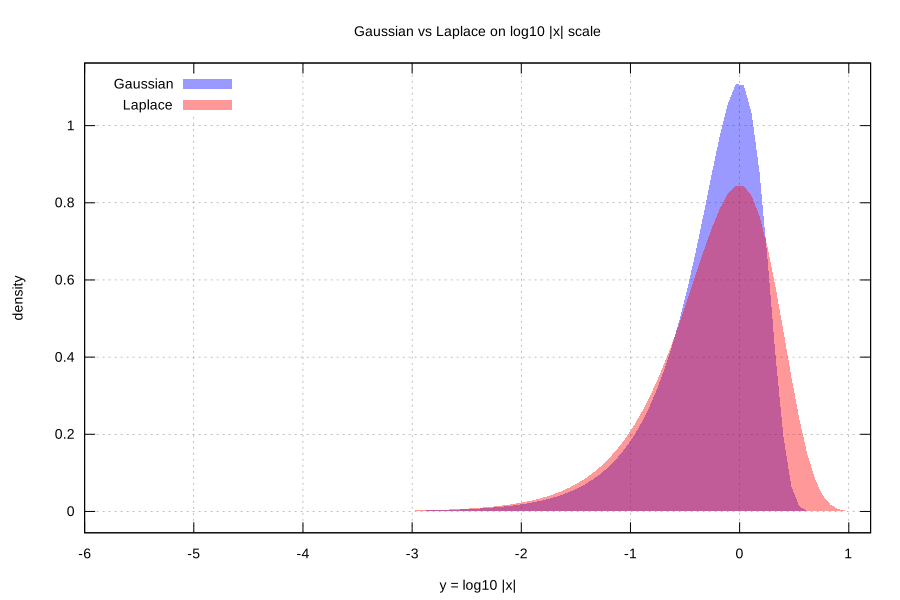
Surely a sparse prior fixes this?
A common intuition is that Gaussian priors are “dense,” while Laplace priors encourage sparsity. So perhaps a Laplace distribution explores the abyss more eagerly.
Take the maximum entropy distribution with fixed mean and mean absolute deviation :
Let . Then
The minimum of exponentials is still exponential:
and therefore
Same scaling as for the Gaussian above!
Near zero, Gaussian and Laplace behave identically.
Both satisfy
So neither prior truly “dives into zero”.
The Laplace prior changes the shape of the peak (it has a cusp), which strongly affects optimization and MAP estimates. But in terms of raw probability mass around microscopic neighborhoods, it is far less different than our intuition suggests.
Go to next post ▤ or ▥ previous post in vault series.